

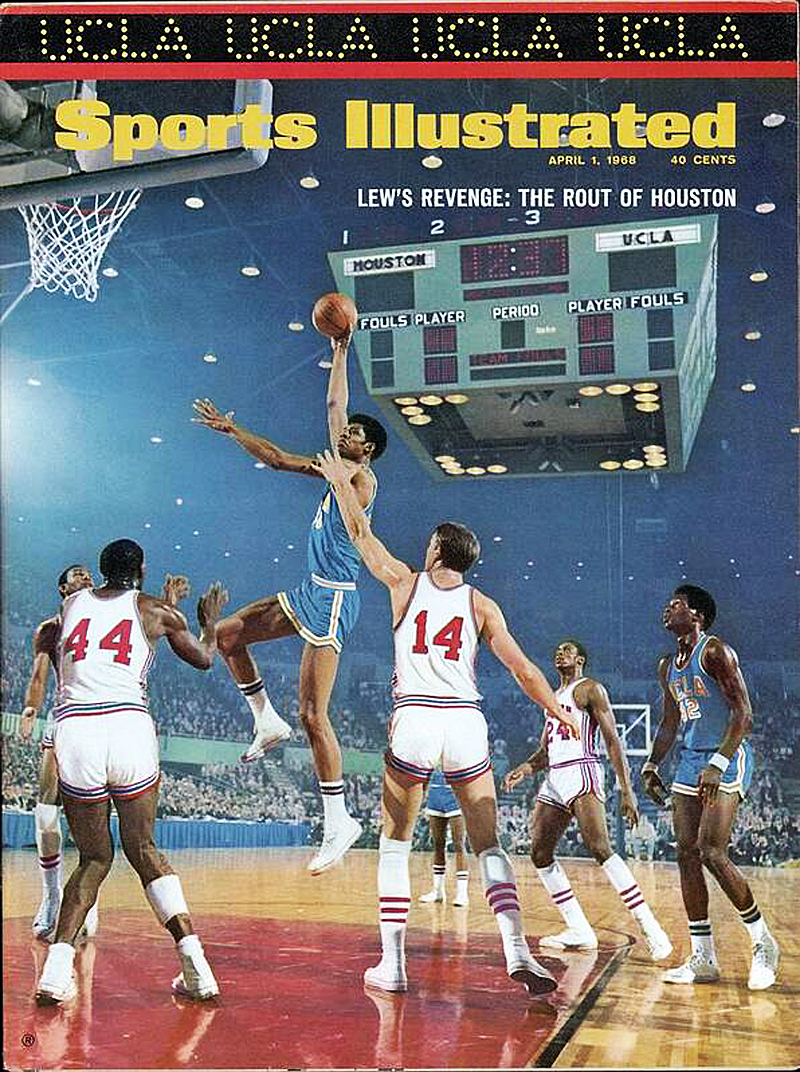
The one big national matchup that people once waited all season to see…Lew Alcindor and UCLA vs. Elvin Hayes and Houston, April, 1968. (SI Cover Courtesy of Private Collection)
Following suit with the popular notion that more is just plain better, and fair – that more mid-major basketball teams deserve a shot – the NCAA expands the basketball tournament to 76 teams.
 The NCAA made a decision last week that promises better sunrises, lower energy bills, and euphoric days ahead for basketball fans everywhere.
The suits in Indianapolis have followed suit with the OHSAA (Ohio High School Athletic Association) in determining that its basketball tournament, both men and women’s, was not offering enough opportunity with 64 teams, deciding to expand the tournament to 76 teams for the 2027 tournament, the largest increase since 1985. Early reports are that mediocre (or at least average) teams everywhere are rejoicing, from $ea to $hining $ea.

VPP Proudly sponsors your favorite basketball coverage on Press Pros Magazine.com.
Surely this fixes a lot of the nation’s problems at a time when all that was missing was the long-dreamed-about matchup between Morehead State and Connecticut – and at a time when the competitive opportunities for Stonehead College basketball must have been at an all-time low. It’s being reported that Stonehead’s best player entered the transfer portal because his congressman told him he deserved a shot at playing Duke in next year’s championship game. Now his future is set.
And when it was announced this week on WLW, in Cincinnati, the morning show host, gleefully professed, “Gee, if this was last year the Bearcats would have made the tournament.”
So there’s the solution to brighter springs ahead…UC in the NCAA Tournament!
A reader from Champaign County was quick to text and share, “Rumor has it that the NCAA chose 76 teams instead of seven divisions…because the jump from the current three divisions to seven just wouldn’t have seemed doable.”
Pity that the OHSAA didn’t have the same foresight!
What all of this pertains to is the next installment of diversity, equity, and inclusion, the guiding light of culture and humanity, where we no longer care about best versus the best. And let no man (or woman) be demanding of the higher standard. Just do your best. That’s all anyone asks. And be believable in the handshake line.

Mark Knupp’s Muffler and Tire proudly sponsor area sports on Press Pros Magazine.com.
Horatio Alger would be clicking his heels right about now. And who doesn’t like a good Horatio Alger story, where hard work and honesty justifies anyone to rise in station from rags to rubbing elbows with the elite? It sold books for the 19th century author by the same name, but will it sell tickets to those who expect better than Stonehead vs. Duke?
It has been explained to me endlessly…how expansion to seven divisions of high school basketball somehow benefits that student-athlete out there who’s never gotten to experience the Final Four – that there’s no such thing as too many champions. That said, there’s nothing said about commitment to the weight room, developing shooting and dribbling skills with both hands, and the mental toughness to compete against someone willing to punch you in the nose…to see how you respond, either.
No, the justification is always about the experience, emotion, and a good human interest story. Everyone gets his time. The handshake line. A ribbon with a medal made of the cheapest alloy available. What we used to call…intramurals!
Now, we don’t mince words. Reach in your jeans and pull out them greens….CASH!
And call it…expanded opportunity.
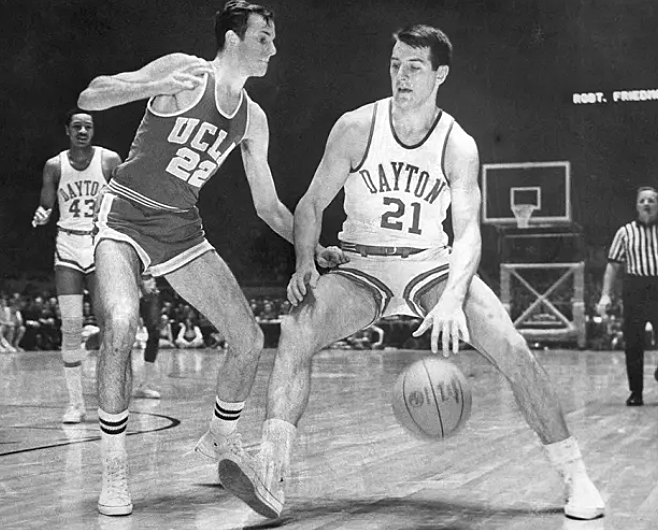
Dayton’s surprise ascension to the 1967 NCAA championship game against UCLA helped trigger expansion then of the tournament.
Personally, I equate it to my first experience watching Nolan Ryan pitch. It was 1972, at Cleveland’s Municipal Stadium on a Sunday afternoon, and I saw Ryan strike out the first three Cleveland Indians hitters on 10 pitches – all fastballs – embarrassingly overpowering. It was an experience, all right. And I was already a sophomore college pitcher, with some success to my credit. But one look at Nolan Ryan instantly told me to stay in my lane – the end of the line. No medal would ever justify me.
I clearly remember when the NCAA tournament was limited to 32 teams, and the conversations at the time. No one talked about a Cinderella much because there weren’t that many really notable teams in the country, media being what it was then. There was no ESPN. The rest were good enough to be on the bracket, but not good enough to play with Coach John Wooden and UCLA, which is why people watched. They wanted to see Lew Alcindor and Bill Walton.
And imagine the surprise in 1967 when Dayton did make it to the NCAA championship game with UCLA, losing 79-64. It gave hope to those out there saying, “See, I told you so.” Of course, teams like the ’67 Flyers came on the heels of other good, smaller teams – Texas El-Paso (’66) and Chicago Loyola (’63) – and those teams helped to trigger eventual expansion and more Horatio Algier stories
Colleague Jeff Gilbert did his best with the topic during this past season when he pointed out how we’ve now grown accustomed to 64 teams…that it makes the bracket pools more fun…and that coaches gain and lose jobs based on NCAA tournament appearances.

Publisher Sonny Fulks writes OHSAA and Ohio State sports for Press Pros Magazine.com.
But he also admitted…”It does lower the standard of the tournament.”
And there was this journalistic gem that only one with Gilbert’s wit and imagination could write: “We’ll see the 17-year cicadas more often than we see a mid-major in the Final Four.” Dickie Dunn never wrote that!
What we’ve gotten accustomed to in high school basketball is coming soon to an NCAA tournament game near you.
After all, seven divisions of high school basketball is what feeds the succeeding levels of competition.
And we’ve yet to figure out what’s feeding the transfer portal and all those Hansel and Gretels out there following the trail of NIL crumbs.
And why are there so many?
“If they could play they wouldn’t be in the portal,” says the well-traveled former NCAA and NBA coach, Larry Brown.
But we never, ever learn. Like many never learn to shoot a lefthand layup, or 60% from the foul line. We just assume…
That someone’s going to pay to watch.

Athletes In Action is proud to be a presenting sponsor of area sports on Press Pros Magazine.com. Call now for camp opportunities for your team in summer, 2026.