

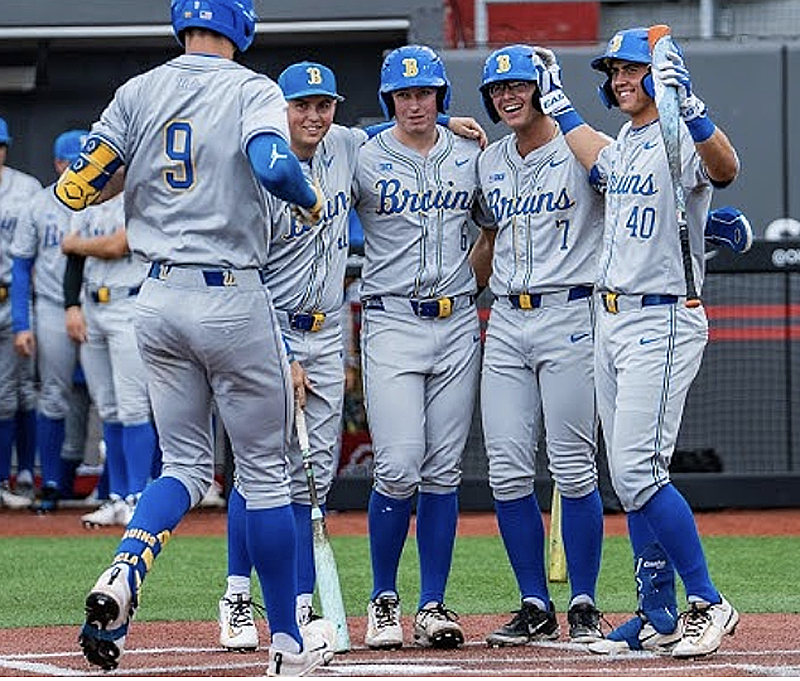
On their March visit to Bill Davis Stadium, UCLA easliy showed it dominance, outscoring the Buckeyes 40-13 in their three-game series. (Press Pros Feature Photos)
As impressive as the Buckeyes’ improvement was – to have come so far in just one year – the Big Ten baseball tournament paints a fine example of how the new neighborhood of the Big Ten lives in comparison to the old neighborhood we used to know.
 Twenty four hours after the Buckeyes lost to Michigan in the elimination game of the Big Ten baseball tournament, people who read the coverage on this website began asking two obvious, and candid questions about Ohio State baseball, Big Ten baseball…and the new conference subdivisions that have sprung up now in Los Angeles, Eugene, and Seattle.
Doug, who reads from southeast Ohio asked: “I think OSU can play against the old Big Ten, but do my eyes deceive me about USC, UCLA, and Oregon? I don’t see people like they have playing at Ohio State.”

Logan Services, with locations in Dayton, Cincinnati, and Columbus, proudly sponsors your favorite area sports stories on Press Pros Magazine.com.
 Doug wasn’t alone. Nor can his question be answered in a single paragraph. Some might say that the answer is cut and dry, but it really isn’t. To begin……
I’ve been around baseball for a long time. And I’ve been around baseball people who played and coached at West Coast schools. When I was working in the minor leagues I rubbed elbows with players from USC, UCLA, and Arizona State…a lot! Players from USC always talked about Trojan baseball – were even arrogant about it – and never hesitant to remind everyone that Southern Cal was a baseball school.
Yeah, they played football come September. They had Heismans and national champs! But make no mistake. USC was a baseball school – Tom Seaver, Dave Kingman, Randy Johnson, Fred Lynn, Mark McGwire, and a hundred more.
They had tradition with coach Rod Dedeaux and the twelve national titles, and they had money behind the program. If by no other source, Dedeaux’s private business, a self-built trucking company, was suspected as the bank behind Trojan baseball for years.
UCLA never had the championship success in baseball that USC had, but coach Gary Adams won over 900 games in 29 years as coach, from 1975 through 2004.
Like USC, there’s no shortage of players from UCLA who went on to big things, while proud to call attention to their UCLA roots: Chase Utley, Gerrit Cole, Dodgers manager Dave Roberts, Arizona Diamondbacks manager Troy Lovello, Brandon Crawford, Eric Karros, and of course…Jackie Robinson.
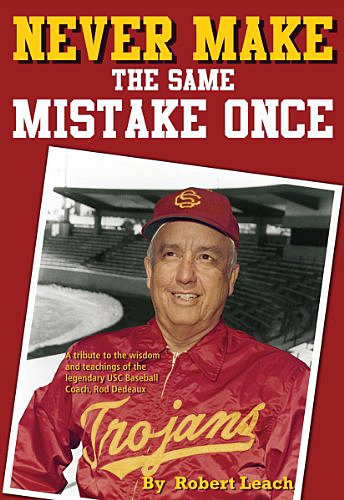
The legend…venerable Rod Dedeaux won 11 NCAA titles with USC and long ago established the Trojans as a national power in baseball.
Oregon is a much more recent notable in West Coast baseball, and the Ducks don’t have that many currently playing in the big leagues, except the Reds’ Spencer Steer. And for whatever financial support the Ducks have lacked from their MLB alumni, they’ve more than graced through the Nike Corporation.
Likewise, Washington is not known as a baseball school, but Washington joins USC, UCLA, and Oregon in having what no other Big Ten school can claim, and that’s outdoor baseball weather year-round. And Washington can also claim a notable relationship with the Bill and Melinda Gates Foundation, and Bill and Melinda Gates, personally, as one of the single largest benefactors among all NCAA schools.
Sadly, for the number of Ohio State players who have gone on to great things in the major leagues – Frank Howard, Steve Arlin, Nick Swisher, Dom Canzone, Dillon Dingler, and my own teammate Barry Bonnell – I’ve never heard anyone refer to Ohio State as a “baseball school”. They’ve played baseball at OSU since 1881 – the oldest sport on campus. But like Iowa talks about the Hawkeyes, and Penn State boasts of the Nittany Lions, all the traditional Big Ten schools are proudly associated with football, and not baseball.
My point with the last 400 words is simply this. Baseball has long been a priority among West Coast colleges because of the weather, and because of individuals like Rod Dedeaux who chose to make it a priority and had the money to do it, or knew someone that did. That phenomenon has never existed in Big Ten baseball, despite the more limited success of traditional Big Ten baseball programs in recent decades.

Chances are, the best lawn on your block is an Ever-Green lawn. Call us at 937-335-6418!
In terms of national titles alone, the PAC 8, PAC 10, and PAC 12 Conferences have won a total 0f 29 NCAA titles in baseball. The Big Ten, collectively, has won 6 – three by Minnesota and two by Michigan (60 years ago), and one by Ohio State in 1966.
If you’re interested, the SEC has won 17 national titles. The ACC has won 4. And Texas schools, among a number of conference affiliations, have won 7 national titles, six by Texas, and one by Rice University (2003).
Clearly, to me three of the four West Coast teams – USC, UCLA, and Oregon – were the most impressive teams in this year’s Big Ten tournament, with however you want to quantify Nebraska as one of the top four seeds.
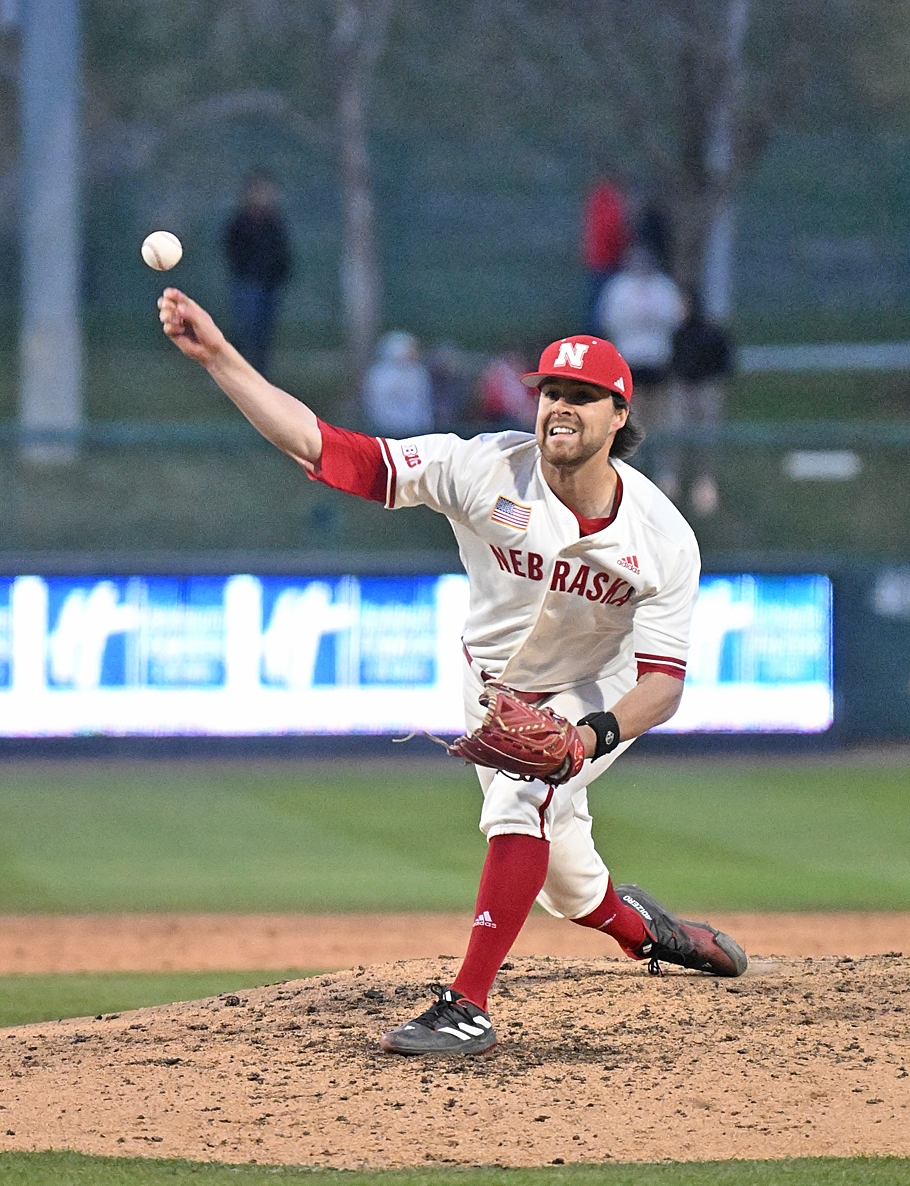
They take their baseball seriously at Nebraska, with sound pitching and fundamentals. The Huskers led the Big Ten in hitting this year with seven starters that hit .300 or better.
Nebraska is another blue-collar baseball program from the tundra that somehow finds a way to play competitively with anyone on a yearly basis. They’ve won the last two Big Ten Tournaments, but that started with former major leaguer Darin Erstad, a notable Nebraska alumni, who came back after a successful big league career to build the program to its current status over an eight-year period from 2011 to ’19. Will Bolt came from Texas A&M to take over in 2020, and hasn’t missed a beat.
And it’s notable to add, for priority’s sake, that 25,000 people showed up to see the Huskers play Oregon on Saturday, and lose 8-0. Yes, the game was played in Nebraska, but the Big Ten Tournament used to be played in Columbus…and 25,000 never showed up at Huntington Park to watch the Buckeyes!
Others have asked over the weekend…what’s the biggest difference between the Buckeyes and the four top seeds – UCLA, USC, Oregon, and Nebraska? That, to me, is a simpler question to address.

Wilson Health/Orthopedics proudly sponsors the best in area sports and the Ohio State Buckeyes on Press Pros.
The number one thing that stands out is the depth of talent. Although, we all witnessed Ohio State sweeping Nebraska in Columbus three weeks ago when the Buckeyes pitched superbly and played their best baseball of the year. So actually, Doug, the Buckeyes do have talent like UCLA, but do they have as much of it?
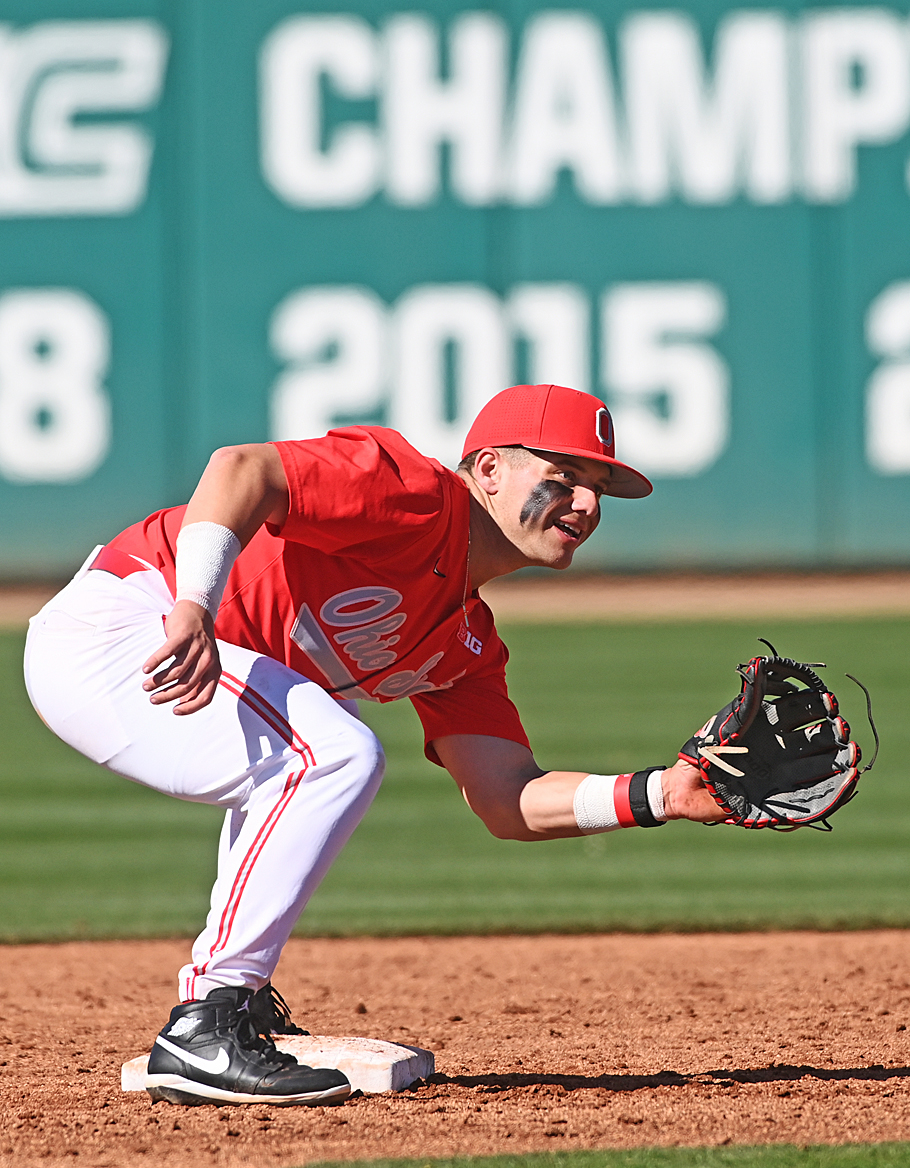
West Coast dominance pushed all-everything Ohio State shortstop Henry Kaczmar to second-team All-Big Ten in 2026. He deserved better.
UCLA swept Ohio State in Columbus back in March, and there are no Roch Cholowsky’s at Ohio State, or at Michigan, Nebraska, or any other Big Ten school currently, prior to the last year’s PAC 12/Big Ten merger.
Cholowky is the projected #1 pick in this year’s draft, and beyond him I haven’t seen another hitter at the tournament to compare with his teammate Mulivia Levu, who beat Purdue and USC on back-to-back days with dramatic walk-off at bats. And beyond those two there are no fewer than four others, pitchers or position players, projected as priority picks in upcoming major league drafts.

VPP proudly sponsors Ohio State baseball on Press Pros Magazine.com.
USC, with former Ohio State assistant Sean Allen as its pitching coach, has the nation’s #1 professional pitching prospect in lefthander Mason Edwards, who struck out 160 hitters this year in 88.1 innings. Ironically, Trojans also have two former Buckeyes, catcher/outfielder Isaac Cadena, and pitcher Chase Herrell. Cadena is the starting catcher and Herrell has pitched 51 innings with a 3-4 record.
No one in college baseball made a bigger impression than Oregon did Saturday, hammering 5 home runs against Washington in their blowout quarter-final win, and another three against Nebraska later in the day in their semi-final 8-0 win. And if that doesn’t make an impression, this does. Collectively, the Ducks roster has hit a staggering 100 home runs this year!
So back to the two obvious questions with Sunday’s Big Ten Tournament championship game.
Are UCLA and Oregon that much better than the rest of the original Big Ten schools, and Ohio State?

Publisher Sonny Fulks writes OHSAA and Ohio State sports for Press Pros Magazine.com.
My answer. There’s no question that the Buckeyes made a quantum step forward in 2026, and not with smoke and mirrors. Pitchers Pierce Herrenbruck and Gavin Kuzniewsky certainly showed their best on the national stage against Rutgers and Michigan.
But, the West Coast schools have certainly raised the standard of competition by their sheer presence, and competitive legacy. They’ve certainly shown baseball in a different priority, and it hasn’t come overnight.
Ironically, Oregon coach Mark Wasikowski was the coach at Purdue for three years before returning to Oregon in 2020. So there’s no question that Ohio State and Michigan can compete on that level if they choose.
Obviously USC, UCLA, Oregon and Washington have the resources, and for whatever reason (NIL, facilities, scholarships, respect, et.al.) they’ve chosen to commit more of them, some way, somehow, to baseball.
There don’t appear to be budget cuts.
And last, you can’t compete with Mother Nature. They don’t wear Carhartts in Westwood.

Dave Arbogast is a proud sponsor of the area’s best sports stories on Press Pros Magazine.com.