

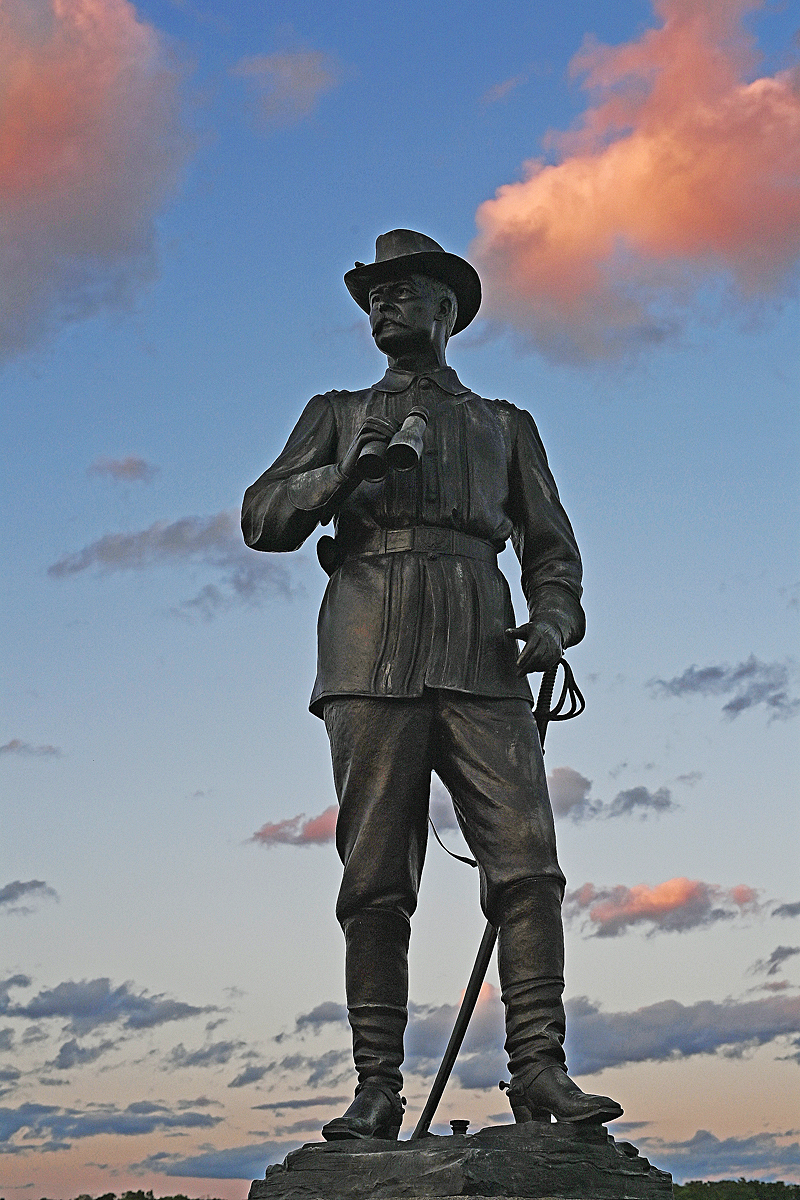
Union general John Buford was the Federal army hero of the first day’s battle at Gettysburg, looking for the Confederate advance (above) with just a small detail of cavalry on the morning of July 1st. (Press Pros Feature Photo)
After returning home from spending the 4th of July at Gettysburg, an interested reader and fellow Civil War enthusiast asks…why is so little actually written about Union General John Buford, and his life after Gettysburg?
 On a slow post-4th of July Wednesday I’ll share an interest received from a reader of our 4th of July column about visions of history at Gettysburg, Pennsylvania, as I was there last weekend on the anniversary of the great battle, July 1, 2, and 3, 1863.
As mentioned in the post of July 4th, several years ago I became associated with the Gettysburg Magazine when it was published by Morningside Books, in Dayton, and since after the publication was sold to the University of Nebraska Press, in Lincoln, Nebraska, approximately a decade ago. And, I’ve served as photo editor of the magazine since, along with writing an occasional columns associated with the battle, or the battlefield, particularly on photography.

VPP, in Versailles, proudly sponsors Buckeyes football on Press Pros Magazine.com.
Over the weekend, a Gettysburg Magazine reader asked me during the recent 163rd anniversary of the battle, “Why with all that’s written about the battle of Gettysburg, and in publications like Gettysburg Magazine, is there so little about [Union cavalryman] General John Buford, who had a prominent role in the first day’s battle on July 1st. “His monument,” wrote Martin Fein, from Maryland, “has always been one of my favorite sculptures on the battlefield, positioned long the Chambersburg Pike on McPherson’s Ridge, west of Gettysburg. I would be interested in your response, if you have the time.”
Mr. Fein’s letter was not exactly a coincidence, as I met him on the battlefield last weekend, and we shared some time together just after dawn on Sunday, July 5th, at the Angle on Hancock Avenue. And knowing that only the most interested of historians are apt to read and appreciate my reply to his question – because Press Pros is a sports site – there are a number of Civil War enthusiasts that do respond to writings about the War. This is the most expeditious means of answering his question…and I have shared with him already where to find my reply, brief as it is.
The way you’re likely to be familiar with Buford’s name and service is through the 1993 movie, Gettysburg, financed by the late Ted Turner, and directed by Ron Maxwell, a screenplay from Michael Schara’s now-famous book, Killer Angels (1974). Buford was a Union army cavalry commander who arrived with approximately 2,000 mounted soldiers prior to the main Union army on June 30, and found himself in the position of delaying the Confederate attack on the morning of July 1st by blocking the road to Gettysburg (Chambersburg Pike) with those horsemen, many dismounted, and whatever artillery fire he could muster. Facing a Confederate division of about 7,500 hundred men. Buford’s cavalry division number about a third of that.
However, he was successful, fighting back the Confederate advance long enough – approximately 3 hours – for the Union 1st Corps infantry to arrive under the command of General John Reynolds. And the significance of Buford’s mastery of the moment was that he prevented the Confederate army from overtaking the town and the advantageous high ground positions around, and south, of Gettysburg. Hence, in the movie Buford was famous for his quote, “We can deny them the high ground.”
After Gettysburg Buford’s continued service to the Union army was short-lived. While harassing Confederate troops upon their return to Virginia, in the fall of 1863 it’s believed that Buford contracted typhoid fever, and died of pneumonia on December 16th, in Washington, DC. He was later buried at West Point Cemetery, at the United State Military Academy in New York.
To answer your question about why so little is shared about the career of Buford, prior to the Civil War he was stationed out West and served primarily as an Indian fighter. Prior to Gettysburg he served admirably at the battles of Second Manassas, Antietam, and Fredericksburg. And while Gettysburg is known as the ‘high water mark’ of the Civil War, the defeat of the Confederate army, post-Gettysburg, was accomplished by General Grant during the campaigns of 1864 and ’65, and without John Buford. Had Buford lived, and had he been involved as a cavalryman, instead of someone like Custer or Phil Sheridan, it’s almost certain that his service resume’ would have been much fuller…and that he would be more well-known.
As for his monument, the sculpture that you speak of is pictured above, and I share your admiration for the significance of its position, approximately seventy five yards removed from the statue of John Reynolds. The photo used here is quite old, probably a decade, and you’ll notice that Buford hasn’t moved an inch in that time, as testimony his to his military discipline.
Thanks for you interest, and kind words. A different kind of…The Reader Speaks!

Dave Arbogast, in Troy, is the official transportation source for Press Pros Magazine.com.