

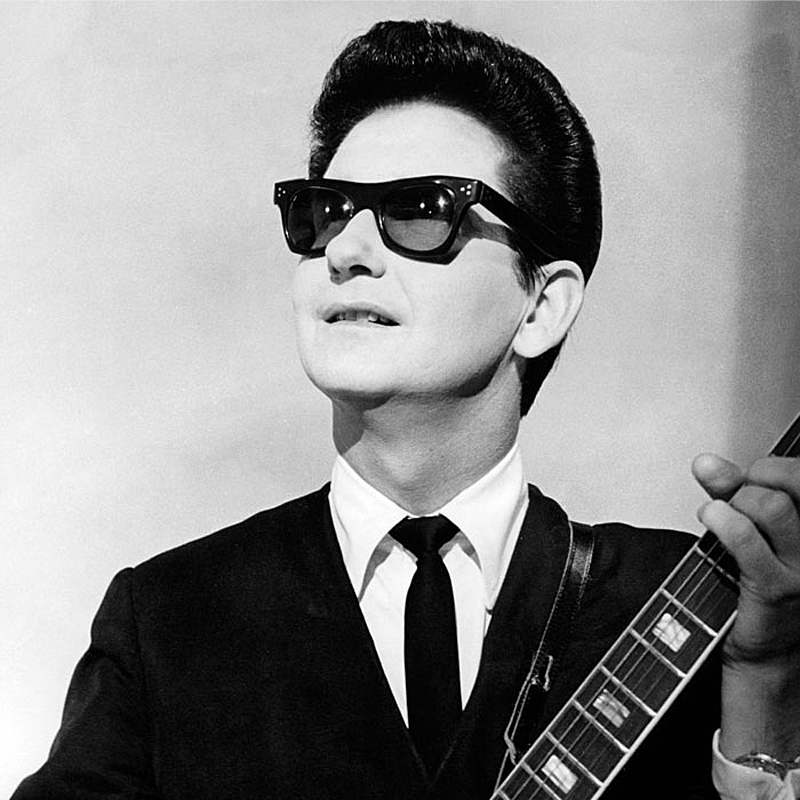
After a fabulous string of hits to begin his career, Roy Orbison overcame personal tragedy to resurrect his career before dying prematurely at 52 years of age.
After years of our telling the story about musicians and the songs that made them famous, a well-known local wrote this week to tell me, “Roy Orbison is one of my all-time favorite singers. And many of his songs are on my list of favorites. Pick one, and educate me.”
 The man, the Reds legend, and the one who wrote to request a Roy Orbison biography was none other than baseball hall of famer and Press Pros original Hal McCoy, whose father was a country singer during Hal’s childhood in Akron, Ohio. So Hal, music, and his interest in the story behind his favorite songs have a bit more depth, perhaps, than the average pop music enthusiast.
 And sure, Hal…glad to share some time on Roy Orbison and a list of songs – Crying, A Love So Beautiful, Only The Lonely, and Running Scared – that only begin to scratch the surface of his incredible abundant career. Frankly, I’m surprised it’s taken so long for someone to write and ask…whatta’ ya’ got on Roy Orbison?
Born in Odessa, Texas, Orbison for a long time was thought to have lost his sight because during the height of his performing career he wore dark glasses on stage. But he wasn’t blind, at all. He suffered from a disease called hyperopia, along with astigmatism and strabismus. He began wearing the dark glasses during a performance with the Beatles in 1963 when he discovered that he had left his regular prescription glasses back at his hotel. The public liked the look, Orbison became known for his mysterious presence on stage because of the glasses, and he kept them as a trademark look.
He was not an instant hit as a musician and performer. Blessed with a crooner’s voice, his shyness with performing failed his confidence in front of early audiences. But his ability to interpret lyrics in an almost tender way was described by one critic as ‘pretty’, and “a lovely personality with the audience’s emotions.” His early songs, recorded on Sun Records, got him noticed. But his string of hits between 1962 and ’66 on Monument Records, catapulted his popularity into the sphere of Elvis Presley’s popularity. He wrote, or co-wrote nearly all of his own songs, including In Dreams, Only The Lonely, Drove All Night, Running Scared, and in 1964…the almost accidental lyrics to Oh, Pretty Woman, what would turn out to be his all-time most popular recording, and a #1 mega-hit on two continents.
Miraculously, between 1960 and 1966 Orbison had 22 singles reach the Billboard Top 40!

Precision Strip proudly sponsors the best in area sports and the Ohio State Buckeyes on Press Pros.
But at the height of his popularity, his career took a dive soon after the release and tidal wave success of Pretty Woman as he suffered through a succession of personal tragedies – an embarrassing divorce, and a motorcycle wreck that cost Orbison his wife, Claudette, with whom he had reunited shortly before she was hit by a pickup truck outside Gallatin, Tennessee. In 1968, while touring, he received word that his home in Hendersonville, Tennessee had burned, killing two of his children.
To overcome his grief he threw himself into his work and shortly thereafter began a collaboration with musicians like Tom Petty, Bob Dylan, Bruce Springsteen, Elvis Costello, Bonnie Raitt, and Jeff Lynne, the bandleader of the Electric Light Orchestra. Within a couple of years Orbison has resuscitated his career, if not his personal health (heart problems and a nasty smoking habit), and was again enjoying rave reviews.
All of his songs became demanded encores on a nightly basis, and in live performance Orbison delighted in giving the audience its money’s worth. But the one that would become his anthem was Pretty Woman, suggested by accident in 1964 when he asked his wife if she had any money with which to go shopping. “A pretty woman never needs any money,” she replied. And Orbison took those words and ran with them. It took him just forty minutes to complete the lyrics that turned out to be a masterpiece, and more playful in nature than some of his previous, darker themes.
In the embedded video above, you get that sense, along with a star-studded lineup of backup musicians, including Bruce Springsteen, J.D.Souther, Jackson Browne, Elvis Costello, Chet Atkins, and Bonnie Raitt.
Pretty Woman rose to #1 on both the American and British charts, where it occupied the #1 spot for 18 weeks. The single sold seven million copies, an incredible number for that time. And it also marked the second time that Orbison had had a #1 song in Britain (It’s Over, 1964), the only American to ever do it.
Orbison fought health problems for the final decade of his life, and was found dead from a massive heart attack in his bathroom outside Nashville on December 6, 1988, at age 52. Had he lived another decade he would have been again acclaimed for the title song of Richard Gere and Julia Roberts’ movie, Pretty Woman. The 1990 film was a box office smash, and once again brought Orbison’s anthem before a new audience of admirers and curiosity seekers enthralled with his hard-to-imagine career.
Without question, the above only scratches the surface of a career so prolific, so underestimated at the time, and so mercurial in Orbison’s ability to rise about the bad times.
This ‘story behind the song’ deserves a book…not a paltry 900 words.

Dave Arbogast is a proud sponsor of area high school sports on Press Pros Magazine.com.