

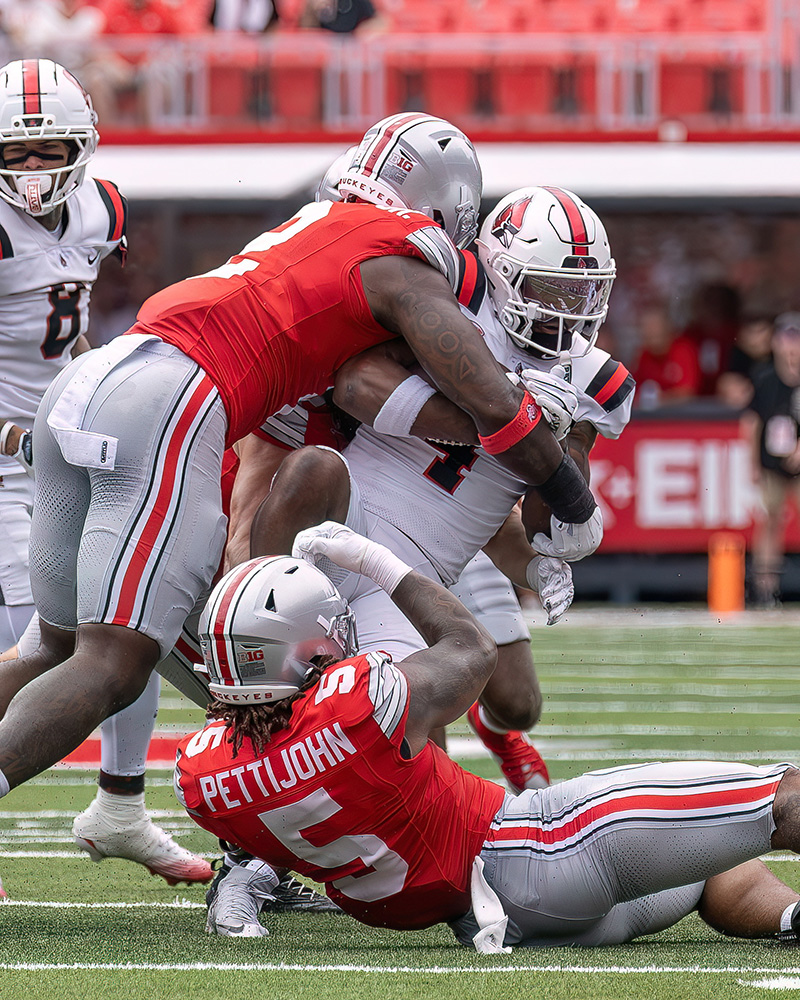
Kenyatta Jackson Jr. and Riley Pettyiohn (5) are key forces in generating a pass rush. (Press Pros Feature Photos)
Saturday’s Big Ten opener will be the perfect time for Matt Patricia to see what kind of pass rush his defense can generate against a balanced Illinois offense, one far superior to the MAC foes they have dominated.
 Columbus, OH – Sacks. Everyone craves them.
Sacks kill drives. One more sack of Arch Manning might have saved the No. 7 Buckeyes from defeat.
“Get him!”

Logan Services, with locations in Dayton, Cincinnati, and Columbus, proudly sponsors your favorite area sports stories on Press Pros Magazine.com.
No matter what else a defense does – shutouts, red-zone stops, turnovers – everyone on the defense, everyone coaching the defense, everyone cheering for the defense, wants to see one thing.
“We always want to get to the quarterback as much as we can,” defensive coordinator Matt Patricia said.

Veteran columnist Jeff Gilbert writes the OHSAA and Ohio State sports for Press Pros Magazine.com. Follow on X @jw_gilbert
When they do, the stands roar, fists are pumped, you jump off your couch.
Ohio State’s sack total through three games stands at an underwhelming four. Considering two MAC opponents and a Texas offense forced to throw a lot in the second half, the number should be higher.
Therefore, when sacks are low in number, well, something must be wrong with the defense.
Maybe not. Maybe a little. Maybe enough to haunt a team all season?
Patricia and head coach Ryan Day expressed optimism about the trajectory of the pass rush after Wednesday’s practice heading into Saturday’s noon Big Ten opener against unranked Illinois (2-1). They realize no one like Chase Young or anyone named Bosa is lining up, striking fear into offensive tackles and quarterbacks. This pass rush – much like the entire defense – is committee driven.

Since 2013, Moeller Trucking sponsors MAC sports and Ohio State on Press Pros Magazine.com.
Sack totals were a point of discussion – sometimes consternation – the past two seasons, but this is the slowest start. A real factor lies in Ball State and Kent State’s rush to get the ball quickly out of the quarterbacks’ hands. The Buckeyes did sack Manning twice: end Kenyatta Jackson Jr. and linebacker Riley Pettijohn.
The question: How will the Buckeyes increase pressure and avoid the double-digit play drives Texas put on them to erase a 20-point deficit?
“We need to be able to get after the quarterback with a three-man rush, four-man rush, five-man rush, six-man rush, maybe seven-man rush,” Day said.
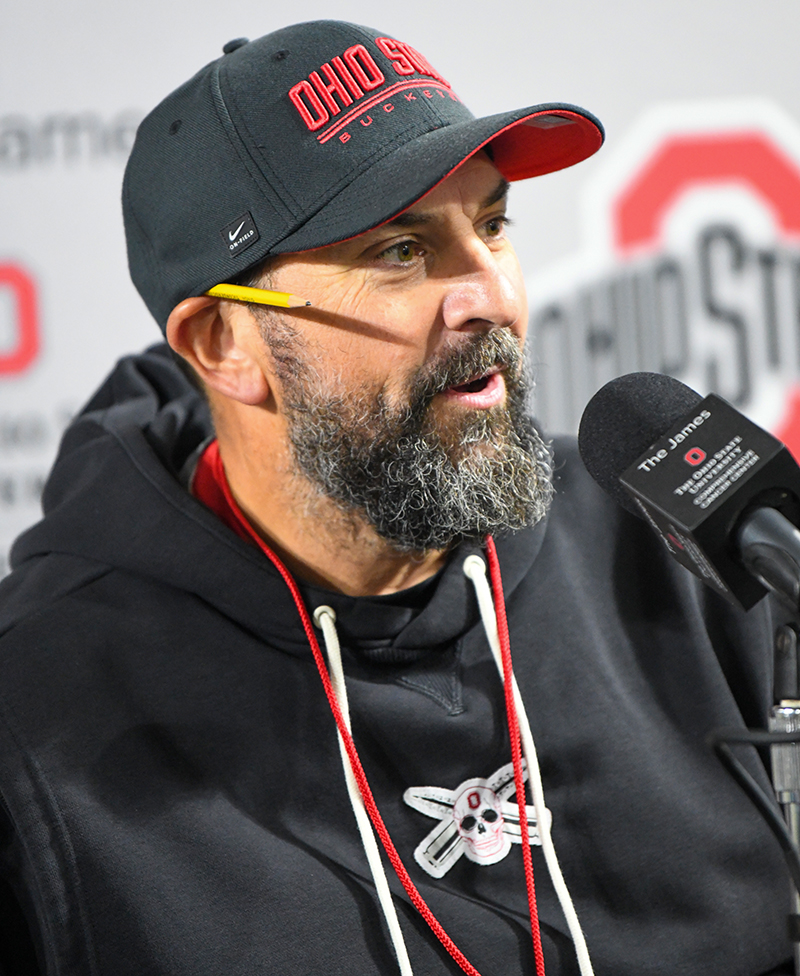
Matt Patricia ramped up the pass rush against Kent State to help figure out who the best players are for the job.
Patricia’s job in conjunction with his staff: Figure out when to employ which rush package and who fits what roles the best. They’re working on it.
Against Kent State, the Buckeyes stuck to their plan to use more pass-rush plays than maybe at any time in Patricia’s 17-game tenure.
“We were trying to see some of the guys that we have on the field and how maybe good or not good they are at some of those different blitz patterns or different looks,” he said. “We’re in the season where you take as many of those reps as you can get. I thought it was a good opportunity to do that for sure.”
Only one sack resulted (split between tackles Will Smith Jr. and Jason Moore), but Dru DeShields felt pressed for time on many plays and completed only 6 of 15 passes for 35 yards. Kent’s biggest pass play was thrown by a receiver on a disguised reverse. And despite getting blown out, Kent ran the football 13 more times than they threw it, doing their best to avoid negative plays.
The key to any good, consistent pass rush that chases QBs from the pocket, puts them on the ground and forces turnovers, is identifying the best men for the job.

Allenbaugh Insurance, in Jackson Center, supports the Buckeyes on Press Pros Magazine.
Not every tackle, end, linebacker, corner and safety are capable of being feared and productive pass rushers. If a team can find three of four, then sacks become a weapon.
The most disruption from the right side comes from senior end Kenyatta Jackson Jr. He sacked Manning and regularly shows up around the football. He figures to be the guy counted on the most to win one on one.
Otherwise, special packages, stunts and blitzes figure to be necessary for this defense to get to quarterbacks. Turning loose the right guys to do it will be crucial. A coach with Patricia’s NFL experience is the guy who can make that happen, according to Day.

Minster Bank is the official banking resource for Press Pros Magazine.com.
“The thing that Matt has always done very, very well, which is the thing that attracted us to bring him here, was his ability to adapt based on his personnel,” Day said.
Creating opportunities for players at each level of the defense seems to be coming into focus for Patricia.
From the first game, freshman end Khary Wilder has been part of the third-down rushmen package, lining up inside and getting into the backfield.
Freshman Jay Timmons won the starting nickel-back job and plays almost as much as the regular cornerbacks, also lining up at safety. His blitz against Kent State helped create a quick throw and Pettijohn’s interception.
Patricia sees Timmons as “super determined” and said he’s seen the “light bulb of confidence” turn on. The first steps of learning one thing at a time have progressed into more, including becoming a guy who might be called on to be a regular blitzer.
“We’re kind of throwing some bricks on top,” Patricia said. “That’s really good to see him be able to handle all that.”
The Buckeyes are playing four linebackers – usually only two at a time – and getting different kinds of production from Payton Pierce, Christian Alliegro, T.J. Alford and Pettijohn, a sophomore.
Pettijohn’s athletic traits make him the obvious choice to be the lead blitzing linebacker.
For Patricia, identifying a linebacker he can move around and turn loose fits right into his NFL methods. He said Pettijohn fits the profile.

Getting to the quarterback like Cody Simon did for the Buckeyes during their championship run is a goal this year’s defense is chasing.
“Explosive power, speed, quickness, a little bit of elusiveness, maybe Gumbyish, where you’re trying to block him and he just kind of slips, and you’re like, ‘How did he do that?’” Patricia said. “If you can try to exploit that and use that, you just find those roles.”
Sometimes a late bloomer finds his role as a senior. This season’s guy might be tackle Jason Moore, a 6-foot-6, 316-pound load in the middle. He made a situational impression when he and Smith Jr. combined for a sack against Kent.
Day speaks highly of Moore lately, and Patricia saw him make a move toward serious playing time in the spring.
“His technique got really good, pad level got good, hands got good, maybe got a little stronger, and then through training camp, he just kept showing up again and again,” Patricia said. “He’s a big dude, he’s long, he’s strong, and so being able to be in the middle for him is going to help us.”
No doubt the entire defense is a work in progress with eight new starters and fewer starters who don’t come off the field than last year’s star-studded unit. The coaches enjoy the depth and the mixing and matching they can do to help the pass rush and other situations.
“This year we have more depth, so there’s more bodies to put into those roles,” Patricia said. “Maybe it’s a little bit more by committee than it was last year at this point and really dialing into those roles for those players.”
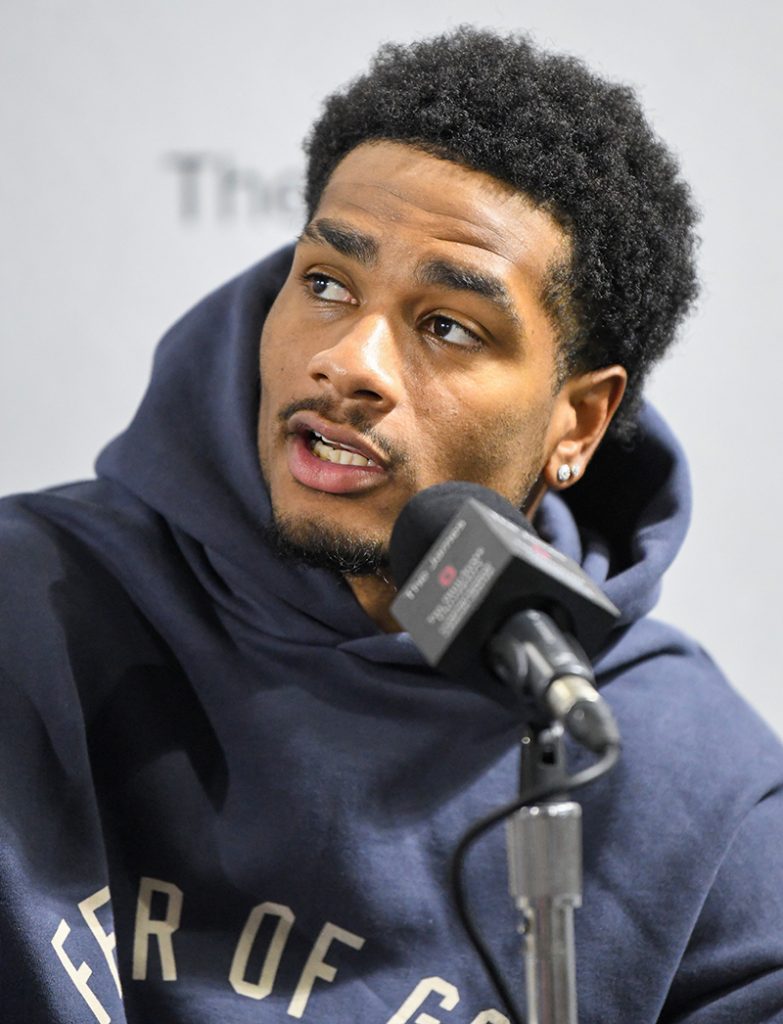
Cornerback Devin Sanchez welcomes the challenge of covering receivers during a blitz.
From the back end of the defense, sophomore cornerback Devin Sanchez likes the idea of more blitzes.
“That’s what we came for,” he said. “Somebody’s blitzing, you got to be able to hold your own out there on the outside or the slot. It’s just knowing that you’re not going to have help all the time and knowing that your coaches are counting on you.”
The biggest challenge for the secondary Saturday will be Illinois senior wide receiver Collin Dixon from Ohio’s Tallmadge High School where he was a 3-star recruit. He’s caught seven touchdowns – most in the nation – from new quarterback Katin Houser and averages 14.7 yards on 25 receptions.
Sanchez said the attention on Dixon will address much more than preventing touchdowns.
“They’re throwing the ball to him all the time, so it’s just knowing where he’s at on the field, in the slot, at three, outside,” he said. “And knowing that whoever’s on them, the ball’s probably coming.”
Especially if Patricia calls a blitz.

The Arbogast family of dealeships proudly sponsors the best area sports stories on Press Pros Magazine.com.