

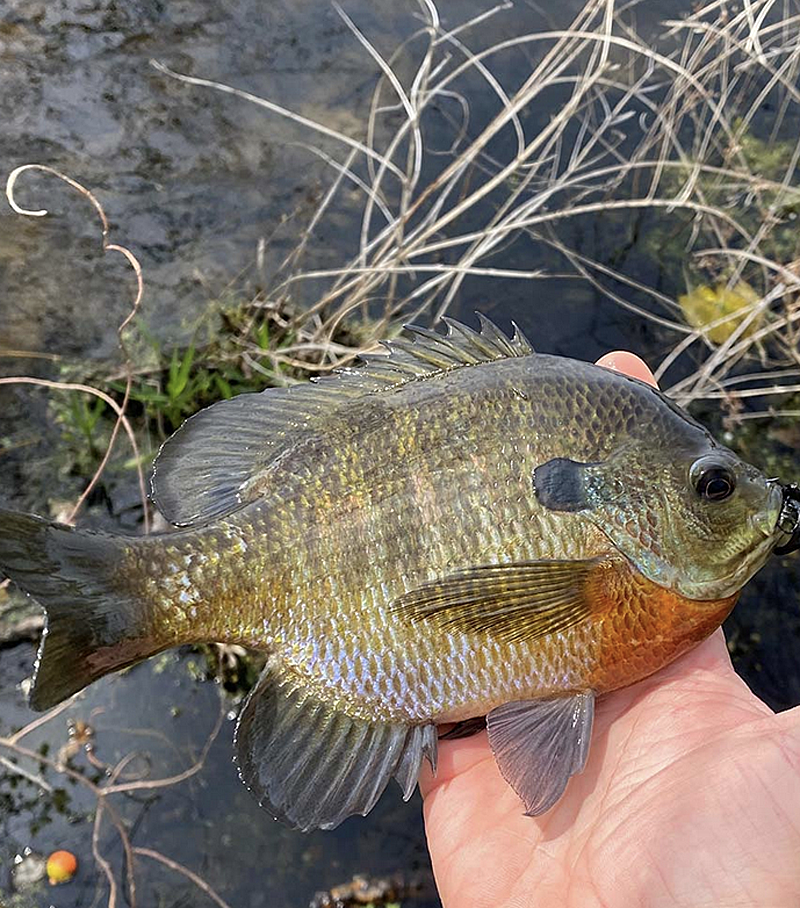
If you haven’t tried creek fishing for bluegills you might be surprised. They’re fun to catch, and the fishing is unpredictably fun. (Photos Provided)
Just back from extended travel in July and August, I came home to Ohio to do three things – fish for fall panfish…walleyes in Lake Erie…and search the woods for squirrels.
By Ray Reilly for Press Pros Magazine
 A month ago I was sitting in Wyoming, too hot to do anything, when the notion took me to call Ohio. I couldn’t wait talk to a friend on Lake Erie and line up a day on his boat for fall walleye fishing.
“It’s been spotty,” said Bill Emmons. “So we’ll have to look for them in the right depth and structure. But we will. Let’s go.”
I got home on September 1, and two days later we were a quarter mile off the Erie shore, fishing in about 40 feet of water. And it was slow.

Olde English Outfitters proudly sponsor area sports on Press Pros Magazine.com.
“This is not good,” Bill said. “Let’s move in a bit. I think we’ll find them closer to shore where there might be more baitfish. The fish are in a transition. It’s worth a try.”
And casting a Rapala crankbait in about 15 feet of water, it didn’t take long to find out. Wham…and I was hooked up with a nice twenty-inch walleye that, indeed, was looking for food.
“It’s that time of year when the wind changes the conditions and where you find fish,” explained Bill. “The wind we’ve been having moves the smaller fish towards the shore and the rocks. The walleyes follow.”
Fishing until noon, we’d had our fill and turned them all back to fish for on another day. But a lesson learned. The trick to catching walleyes in the fall is to know the water and bait conditions. Like other species of wild creatures, fish change with the conditions and you have to change accordingly. Had it not been for Bill Emmons, I might still be out there throwing baits in forty feet of water, never thinking that the fish move with the food source. Lesson learned.
A few days later I was on route 23 south, driving through Chillicothe, Waverly, and down to the Ohio River before turning east towards Lawrence County and another friend, Ralph Lewis, who said he would show me some bluegill fishing the likes of which I hadn’t experienced before – not in a farm pond, or in Vesuvius Lake, outside of Ironton.
But in Symmes Creek, a tributary that flows into the Ohio River at Chesapeake, where Ohio route 7 merges to take you up the river towards Proctorville and Gallipolis. Ralph lives across the river in West Virginia, but likes to fish the deep holes of creek water, like Symmes Creek, as far north as Waterloo, some thirty miles from Chesapeake.
His trick is to fish with red worms (or night crawlers) on light tackle, suspended in water just off the bottom. And as he explained to me, the bigger the worm, hooked through the band so it can dangle naturally in the water, the bigger the fish it attracts.
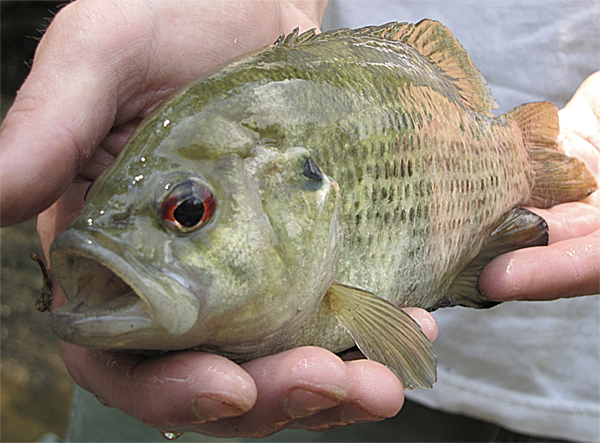
Why try creek fishing? You never know what you’ll catch, or how big. Nice eight inch Rock Bass from Symmes Creek, in Lawrence County.
“Just be patient and move the bait slowly just above the bottom,” he explained. “Water is down right now and they’ll be hungry. And be ready, because you could catch smallmouth and catfish just as easy.”
Fishing with two-pound line, we got on the water about four miles out from Chesapeake and Ralph was hooked up before I even noticed.
“Nice fish…big female,” he grinned.
And a fighter, too. He played it like a Stradivarius before reaching into the murky creek water and pulling the fish in with a small net. About six inches, he released and bragged, “There’s bigger ones.”
Moments later I was pulling on my own Symmes Creek bluegill, or so I thought, hooked just off a fallen tree branch in about four feet of water. It turned out to be a nice smallmouth, nearly 12 inches.
“You get a few of those in here,” said Ralph. “But more rock bass, usually.”
Likewise, I turned it loose and rebaited. On the first cast something attacked it. Ralph yelled, “Bluegill, and a big one. Don’t lose that fish.”
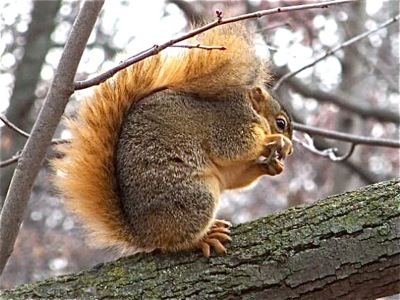
Early season squirrel hunting is about finding a food source, den trees, and being in the right place at the right time.
A second later he had his own action out or the same space, in about six feet of water. Pulling some drag as it tried to zig-zag and get away downstream, mine eventually tired and came to hand, and as it turned out…the best fish of the day. On the handle of Ralph’s net he has a 12-inch ruler marked and my bluegill measure just shy of 9 inches, thick and a prime candidate for the skillet.
His turned out to be just shy of eight inches, the first two of about eight fish of that size that we caught out of that same hole.
“Where you find them, you find them,” Ralph added. “They going to be scattered still, but a month from now they’ll begin to cluster together in deeper water as things cool down. Nearer the river, some even move out into the deeper channels. That’s why September creek fishing is appealing to me. And you never know what you’ll catch.”
Before the afternoon was over he had proven his point. We had caught twenty bluegills, a catfish, three rock bass and that one smallmouth.
That night we cleaned our bluegills and ate like kings, scaling and scoring the fish, and cooking them whole over charcoal. With fries and hush puppies, I’ve never had better.
Still to manage before the trip back to northern Ohio was a day or two squirrel hunting on that same Symmes Creek, just south of Waterloo. Squirrel hunting was one of my first outdoor experiences as a kid in Mahoning County, and when the leaves begin to turn I begin to look to the woods, where often as not I’m the only person there.
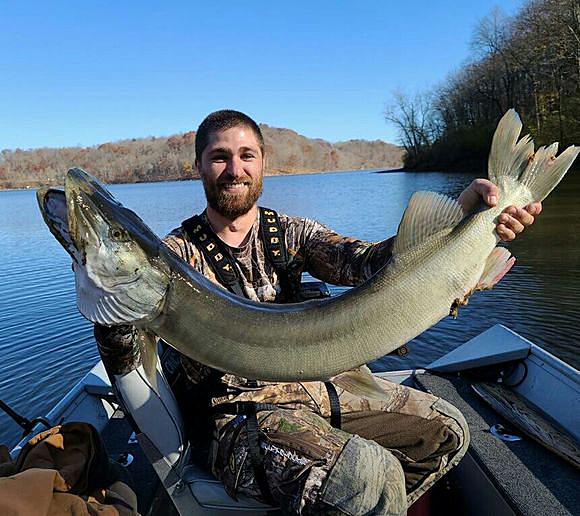 People don’t squirrel hunt, anymore. It takes time, it takes patience, and it’s easier to go to the local Burger King if you’re hungry. Hunting to eat is out of the question in modern culture.
Armed with a 20 gauge Remington and Ralph’s old .410 Winchester Model 42, we found some creek banks that bordered standing corn on an acquaintance’s cattle farm.
“They’ll cut this corn for the silo in a few days, so this is just about right to catch some big fox squirrels between their den trees, the food source, and the creek,” said Ralph.
In theory, yes. In actuality, it turned out to be tougher than planned. We saw squirrels, yes, but they were on the ground and on the move as we heard them rustling among the standing corn, breaking down stalks to get to the grain. If it was too green to yet eat they changed tactics and moved on. We changed tactics, too, and tried to get between them and the den trees.
Plenty of squirrels? Probably, but by evening we had decided that we were too early to hunt the unripe and standing corn – dangerous, and the question of damage to the corn. The squirrels were doing enough of their own.
However, a day or two on in the outdoors is always better than in the car and by the time I caught route 35 north for Columbus I was happy to have learned that there’s always a new way to catch fish.
And why one more time I was reminded about why hunting is called hunting…and not shooting.
‘Til next time, I’ve enjoyed it.


Olde English Outfitters proudly sponsors coverage of the outdoors on Press Pros Magazine.com.