


You put your best athletes up the middle – catcher, shortstop, and center field – but 37.5% is still less than the percentage found in basketball and football. (Press Pros File Photos)
On the eve of next weekend’s state tournament finals in baseball, I’ll share with you…again…why baseball is the toughest of all the OHSAA titles to win.
 With two area teams involved with next week’s OHSAA baseball finals (St. Henry and Delphos St. John), I’m going to share again something I wrote years ago…on a topic about which at the time there was some disagreement.

Minster Bank proudly sponsors the best in area sports stories on Press Pros Magazine.com.
And that is, whatever happens next weekend in Akron will represent the toughest title of all the OHSAA championships to actually endure and come out on top. And with or without bias, I’ll not only make my case but share the opinion of others who over the years have confirmed…that a title in baseball is tougher to win than football and basketball.
But before I do, let me add that I think this year’s tournament will again be particularly interesting given the trend of fewer kids actually playing high school baseball, and the fact that many who do are playing more games without actually practicing the skills that actually make you a more competitive player, as Nebraska coach Will Bolt told me this spring.
There are the five requisite tools of baseball, of course: Run, catch, throw, hit, and hit with power.

Publisher Sonny Fulks writes OHSAA and Ohio State sports for Press Pros Magazine.com.
You see it…struggles to put down a dependable sacrifice bunt.
Catchers who haven’t played the position long enough to be adept at framing strikes, or blocking the ball in the dirt.

The Keyhole supports all local sports on Press Pros.
And infielders who have not thrown enough on their own, or are not strong enough, to be confident in making a strong, snap throw to first base. I see a lot of second basemen shot-put the ball to first for fear of making a more aggressive, natural throw.
A coach in the minor leagues once shared this with me about why baseball is the toughest sport in which to be a champion.
In high school football you play eleven, and you’re probably going to have about six good athletes on the field – quarterback, running back, wide receiver, at least one good linebacker, and usually a couple of interior linemen (54.5%).

Minster Dental proudly support area sports of all sorts on Press Pros.
In high school basketball the team that has three good athletes will usually have a winning season, and even a good tournament run – point guard, shooting guard or forward, and a strong post player (60%).
In high school baseball you’re usually pretty good if you can play your best athletes up the middle – catcher, shortstop, and center field. The rare exception is the team that has a good player at second or third base, as well, but for our purposes, three out of the eight positions (37.5%). In most cases the two corner infielders are there because they don’t have great range, or enough range to play short or second. More than one coach has told me over the years they hold their breath late in the game with men on base if the ball is hit to left or right field, and that fielder has to make a running catch on the ball. Again, you put your most dependable hands in the middle of the field.
Old-time baseball men used to say that you can’t hide in baseball. The weakest link on the field at some point will have to make a play or a throw to save a run, or the game. That’s what makes baseball such a great developmental experience for kids.
But here’s the real reason the state tournament is so tough to win in baseball.
Pitching!
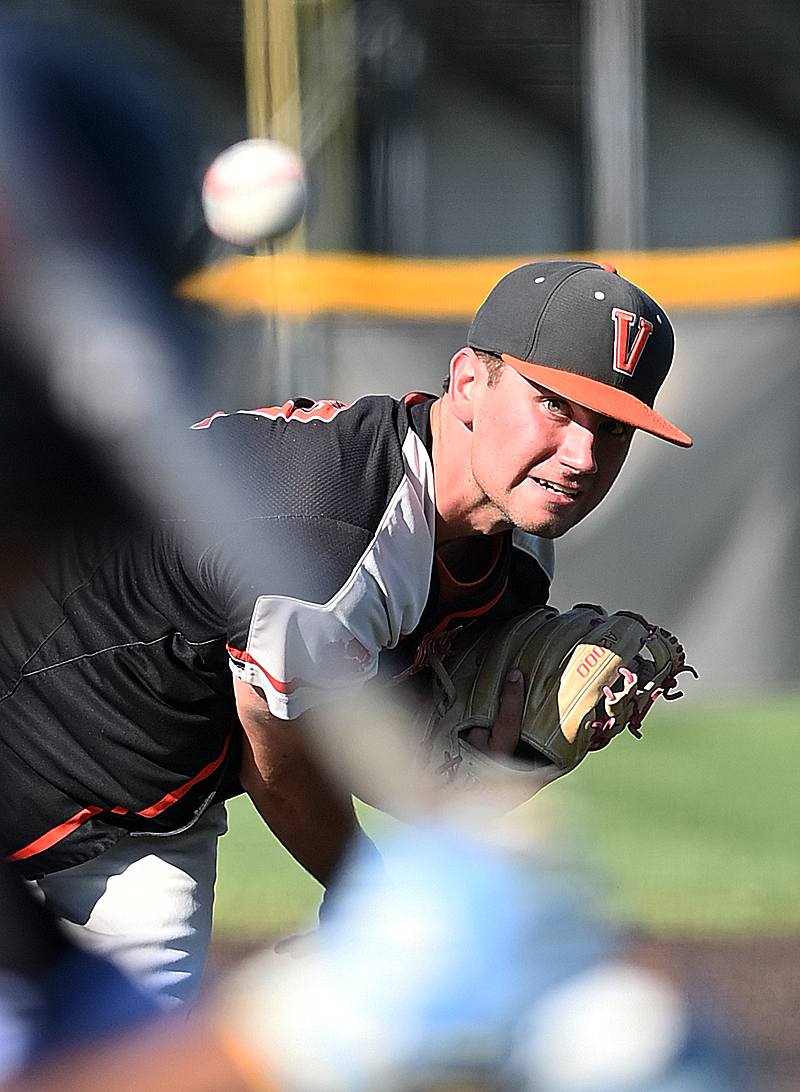
To win a state championship in baseball you have to have two dependable starting pitchers, and because of the pitch count you have to have two others who can dependably throw strikes. And luck helps, too.
You need at least two quality starters, one to get you through the semi-final game, and one that can win the final if you get there. You have to have two bonafide #1 pitchers to win the state tournament. And then you need at least one, or maybe two, strike throwers among your eight position players that can come in and throw strikes, and throw hard enough to make hitters miss. Bonafide #1’s? Most high school teams struggle to have one.
A major league scout at the Big Ten Tournament recently told me that only about 15% of high school teams – good high school teams – have more than one #1 pitcher, a guy who can throw with velocity and execute an off-speed pitch. “There are high school teams out there who have that, even three, but you don’t see it very often,” he said. “The trick is to have two other good athletes that can come in a game and throw strikes in relief. Those are usually your best teams.”

Huffer Chiropractic can help your athlete perform at their best – with offices in Osgood, Jackson Center, Marysville, and Dublin, Ohio.
So, out of about 850 OHSAA schools that means 125 teams might qualify. And of course, the pitch count rule plays a role. You can’t do what Ohio State pitcher Steve Arlin once did in the 1965 College World Series. Arlin threw a 15-inning complete game, struck out 20, and threw between 230 and 250 pitches to do it. A year later, in the 1966 Series, Arlin made five appearances over five days, threw 20.2 innings, and struck out 28 hitters. That’s a no-no in high school baseball, regardless of skill and durability.
More, how many high school programs have a coach experienced and qualified to teach the art of pitching? Most have someone who, himself, pitched in high school, but few have someone like Troy High School’s Heath Murray, who actually pitched for parts of five years in the big leagues, schooled in the nuances of pitching mechanics, and mindful that one size doesn’t fit all with young pitchers.
You hear it said by coaches in any sport that you have to be good, yes, but you have to be lucky, too. Its a team game, but like the man said…you can’t hide.
A few years ago, when the tournament was played at old Cooper Stadium, on Mound Street in Columbus, I saw such a kid in right field backpedal to make a routine catch, get his feet caught in the turf, and fall flat of his back as the ball was coming down. He lay there like a Lady Bug on its back, arms outspread, and in no position to make a play. Only, somehow he reached up, got his glove on the ball, and it stuck there. He made the catch for the out, saving his team at least two runs.
Yes, you’ve got to be good, but sometimes you need to be lucky. Good is earned, while luck comes and goes.
It takes both, but remember. No other sport requires pitching – throwing strikes, execution with home plate, that’s 17 inches wide, and 60 feet, 6 inches away.
It makes baseball the toughest title to win.

Wilson Health/Orthopedics proudly sponsors the best in area sports and the Ohio State Buckeyes on Press Pros.