

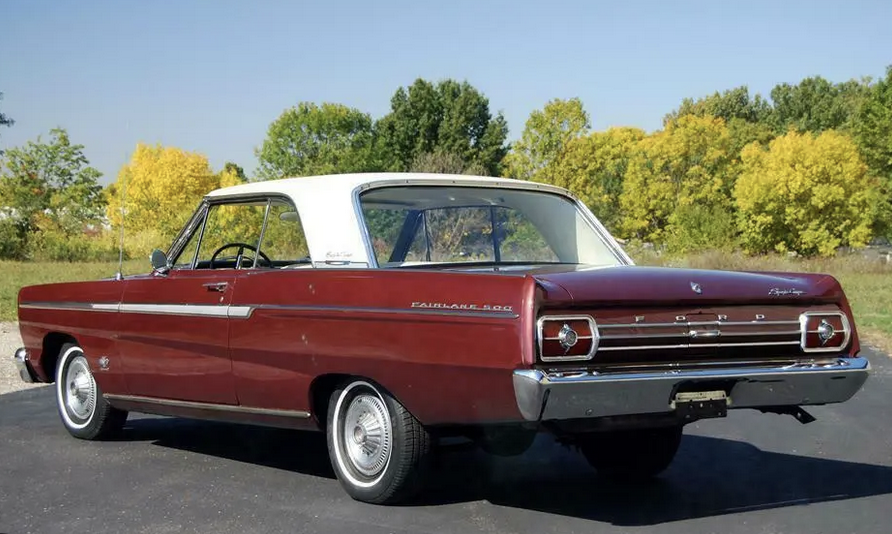
A Ford Fairlane 500 similar to the one that Roberto Herrera drove during his two weeks in the Florida State League. (Press Pros. Feature Photos)
Forty-five years have passed since my days as a minor league umpire, and a week of DEI in the old Florida State League gone wrong. And it does make you wonder…why anyone would ever want to be an official?
 On the opening week of the baseball season I still wax nostalgic to some of my days and misadventures nearly fifty years ago…those days of misguided career choices when upon leaving Ohio State University I went to the Major League Umpire School, in St. Petersburg, Florida, finished in the top handful of the class, and immediately got a job working in the minor leagues.
You talk about romance? Every day when I walked into the umpire room of one of the major league spring training parks I could literally smell Dodger Stadium and hear the roar of a World Series crowd.

Minster Bank proudly sponsors the best in area sports coverage on Press Pros Magazine.com.
Having just spent four years as a college pitcher, I had a good idea of the strike zone, and I quickly learned that balls and strikes were what kept you out of trouble as an umpire and made you a prospect to move quickly through the minor league system.
Publisher Sonny Fulks writes OHSAA and Ohio State sports for Press Pros Magazine.com.
I was young, athletic, moved well, and dedicated myself to knowing the rules of the game outside of just knowing the book. Having played all my life, I had great instinct for how the game was played and how to anticipate positioning yourself to make the proper calls.
My first full year in A Ball I spent with a future major league umpire, Steve Rippley, in the old Florida State League – a league comprised mostly of major league teams’ top draft choices and prospects for the big leagues. That year went by without a hitch, despite the arguments and the occasional ejections. I quickly learned the personalities of managers like Jim Leyland, Jack Hiatt, and Stump Merrill and how to navigate their mood swings on the field.
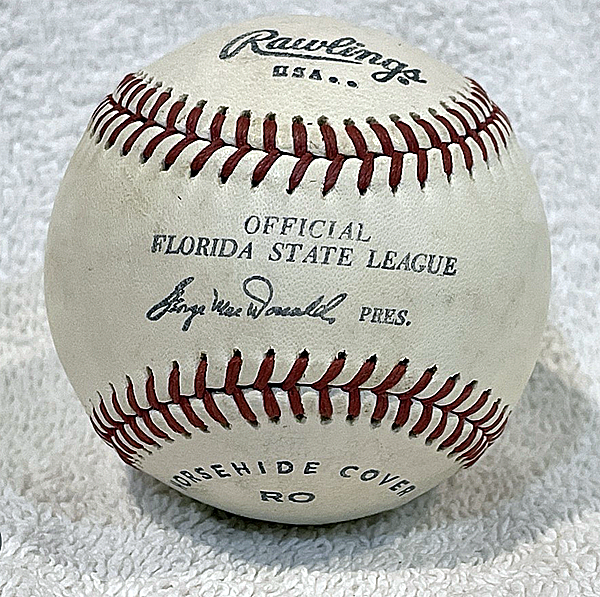
Hoping to move up to Double A the following season, I was disappointed the following year when I learned in spring training from Florida State League president George MacDonald that I would be starting the year again in A Ball.
“I need to have you for a few weeks to work with some new guys just coming in from Rookie Ball,” he said. “I need your experience to help them get their feet on the ground.”
His left-handed compliment was noble, but having had a solid year the year before in A Ball, I was looking to follow Rippley, who had been promoted to the Double A. Nonetheless, when I got my opening day schedule it was a three-game series with Cocoa Beach and Winter Haven, and my partner was a guy named Roberto Herrera.
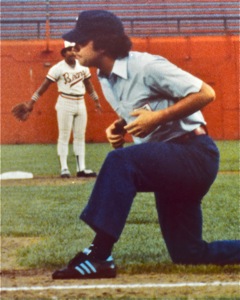
My days as an umpire…A photo from AAA baseball, Denver’s Mile High Stadium, circa 1980.
When I showed up in Cocoa Beach early on that Friday morning I checked into a $10 room at the local Holiday Inn, and inquired about Herrera.
“No one by that name here,” said the desk clerk. And by 4 o’clock that afternoon I was beginning to get nervous. When I called the league office the secretary was no help. “Haven’t heard from him,” she said sweetly. “I’ll tell Mr. MacDonald.”
By 5 p.m. I gave up and drove to the ballpark, recently vacated by the major league Houston Astros – their spring training camp. The clubhouse man showed me to the umpire’s room and when he opened the door and I walked in there sat Roberto Herrera.
Herrera was the immense man of Cuban descent, a former first baseman in the Mexican League, who didn’t speak a word of English and stood about 6’5″ and weighed in the neighborhood of 240 pounds. Within minutes MacDonald, himself, popped into the room to make introductions.
At the time the major leagues were seeking to become more racially diverse in its umpiring candidates, following the example of Emmett Ashford in the American League, and Art Williams in the National League. And, they were looking for umpires that made a bigger physical impression on the field. Herrera qualified on both counts, despite never having umpired before.

EB Real Estate, Darke County’s sales leader, proudly sponsors the best area sports on Press Pros Magazine.
“I want him to work with you for a few weeks so he can learn as much as possible,” said MacDonald.
In the meantime, Roberto Herrera had yet to speak a word. When MacDonald introduced us, he stuck his hand out and simply said, “Her-r-rer-a”, rolling his r’s with the pronunciation of his name.
“I want you to work the plate for the first couple of games until he gets accustomed to things,” MacDonald added. Then he smiled and left.
The man was six inches taller than me and outweighed my by at least seventy pounds. And I had no idea if he had gone to umpire school, or not, because we couldn’t communicate. He was so big that when we walked to home plate to exchange lineup cards his hat was too small and sat perched on his head like a teacup. As it turned out, he knew nothing about umpiring mechanics for a two-man system. Rather, he just wandered around the field chasing the ball and chasing plays. He was fresh out of the Mexican League, where he had retired as a player the year before, and someone thought his future might be in umpiring. George MacDonald took the bait.
 He literally spoke no English, and when the managers introduced themselves at home plate that night all he could say was “Herrera”, and he would stick out a hand that was the size of a coal shovel. The first game, itself, was uneventful, and afterwards I discovered that he didn’t have a hotel room because he had taken the advance that the league had given him to save for gas and food. He slept in an old Ford Fairlane that he was driving, parked in the stadium parking lot.
By the second game there were issues. Herrera couldn’t communicate, and he couldn’t umpire. And minor league players and managers, who were out for their own advancement, were not playing ball for the sake of diversity and equal opportunity in umpiring. And every issue and disagreement that he had he managed by bringing the problem to me.
Finally, things came to a head when with men on first and second base and one out, there was an infield popup that I immediately called an infield fly, and the batter out. Only…Herrera came running towards home plate holding one shoe in his hand, claiming that there was no play because his shoe had come off before the pitch, and he didn’t know how to call timeout. Winter Haven manager Rac Slider went nuts because he had lost the out, and had lost patience with the whole Herrera experiment after just two games.

VPP proudly sponsors area baseball on Press Pros Magazine.com.
Two days later, in Fort Lauderdale, during his first attempt at balls and strikes, he failed to call anything on a 3-2 pitch with two outs and the bases loaded in the fifth inning of a 2-2 game, claiming that he hadn’t been ready for the pitch. Obviously, there were problems again because the pitch was right down the middle for strike three, and would have been the final out of the inning. Amidst all the yelling all you could hear was Herrera bellering, “Som-beetch…Som-beetch…Som-beetch” at the top of his lungs, while waving his arms like he was fighting off bees. For years I kept a legal pad notebook about what I had encountered in the minor leagues, and all I could think of to write about that night was “three ejections…and this isn’t working.”
Unbeknownst to me, George MacDonald met with Herrera privately the morning following that game in Fort Lauderdale, and when I came to the ballpark that night there was a new partner waiting for me in the locker room. The next morning the phone rang in my hotel room room and MacDonald was on the other end.
“I’m down in the lobby,” he laughed. “And I want to see you.”
Expecting the worst, I met him five minutes later.
“I appreciate you trying,” MacDonald laughed. “And just to show you how much I appreciate you…Herrera is going back to Mexico, and you’re going to Double A tomorrow. Report to Orlando for their series with the Charlotte Orioles.”
I looked recently online at Roberto Herrera’s minor league and Mexican League statistics as a player.
He was 38 years old when he tried umpiring, a veteran of 21 seasons of baseball in the American minor leagues and the Mexican League, where he retired after the 1976 season with a .313 career average, 155 home runs, and 884 runs batted in. The page also said that he had died on December 27, 2018, in Homestead, Florida…just weeks short of his 80th birthday.
There was no mention of who got the Ford Fairlane.

Wilson Health/Orthopedics proudly sponsors the best in area sports and the Ohio State Buckeyes on Press Pros.